Category Archives: Gallery

Visual art and culture from The Funk Jazz Lounge

Gordon Parks: Voices in the Mirror — The Photographer Who Scored Shaft, Before the Show Closes Nov 7

One important note about the headline’s musical connection: Gordon Parks directed Shaft, but Isaac Hayes composed its celebrated score. Parks did compose the score for his own film, The Learning Tree.

A photograph can hold a moment still. But what happens when the people inside that image get the chance to speak back?

At Jack Shainman Gallery in Tribeca, Gordon Parks: Voices in the Mirror returns to photographs we may think we know and invites us to encounter them anew. The exhibition pairs Parks’s images with reflections from the people he photographed and, in some cases, their families. Their memories bring new intimacy and context to work that has shaped how generations see Black life, history and beauty.

The show marks the 20th anniversary of The Gordon Parks Foundation. It is on view at 46 Lafayette Street, New York, through November 6, 2026, according to the gallery’s exhibition page. With only days left, this is a moment to make the visit if you can.

Artwork installation view from Gordon Parks: Voices in the Mirror at Jack Shainman Gallery

The people in the pictures speak

Parks was known for looking beyond the surface. In Voices in the Mirror, that attentiveness comes into sharper focus through recollections from people whose lives crossed his lens. The photographs are not presented as distant historical documents; they become the beginning of a conversation across time.

Among the contributors is Cora Taylor, reflecting on Parks’s 1956 Life magazine photograph At Segregated Drinking Fountain, Mobile, Alabama. The image belongs to his landmark series documenting the everyday realities of Black Americans living under Jim Crow laws in the rural South. Taylor recalled being present for the photograph and seeing it later in Life. Her perspective adds a human dimension to an image long regarded as part of the visual record of segregation.

That shift matters. We are invited to consider not only what the camera captured, but what it felt like to be there: the uncertainty, the awareness of danger, the small decisions people had to make in an unjust world. The photograph remains powerful; the subject’s own memory makes its meaning more layered.

Other reflections bring fresh insight to images connected to the families of Muhammad Ali and Malcolm X, among others. The result is not a replacement for Parks’s vision, but a fuller encounter with it: one shaped by the people who knew the moments from the inside.

A career that moved between image and sound

Parks’s creative life never belonged to one medium. He was a photographer, writer, filmmaker, composer and musician, moving between forms with a fluency that feels especially at home in a city’s cultural rhythm.

In 1948, Parks became the first Black staff photographer at Life magazine. Over the following decades, he made portraits and photo essays that brought attention to people and stories too often overlooked. His work could be intimate and unsparing, but it also carried a deep respect for his subjects’ humanity.

Film offered another way to tell stories. Parks wrote, directed and composed the score for The Learning Tree (1969), adapting his autobiographical novel for the screen. The film marked a major milestone: Parks was the first African American to write and direct a major Hollywood studio feature. The Gordon Parks Foundation’s film archive offers more on his work across cinema.

And then there is Shaft. Parks directed the 1971 film, helping bring its stylish, streetwise world to the screen. But its unmistakable score was composed and performed by Isaac Hayes. The distinction matters, and it makes the music-and-photography connection no less compelling. Parks understood how sound, image and mood could work together to tell a story. His own work on The Learning Tree demonstrates that directly.

A second installation view from the exhibition, showing Gordon Parks photographs presented alongside reflections

Looking closely, listening differently

There is a musical quality to the way this exhibition asks us to pay attention. A photograph offers a frame; a subject’s reflection opens a new passage beyond it. One voice brings forward a detail, another adds a memory, and the image begins to resonate differently. Like a well-arranged record, the experience rewards a second listen.

That is one reason Parks feels so relevant to a place like The Funk Jazz Lounge, where music, poetry, art and culture belong in the same conversation. A photograph can have rhythm. A written recollection can feel like a verse. And a song can change how we see the scene around us.

Parks’s work also reminds us that art is not only about the person behind the camera. It is about the exchange between photographer and subject: the trust, the attention, and the moments that continue to live after the shutter closes. In Voices in the Mirror, those moments are still unfolding.

The exhibition’s title comes from Parks’s final memoir, published in 1990. It feels apt here. A mirror does not simply reflect; it asks us to look again, and to notice who is looking back.

A closing-week invitation

If you are in New York, consider making time for the show before it closes. The exhibition is at Jack Shainman Gallery, 46 Lafayette Street, Tribeca, and the gallery lists its final day as November 6. Check the official exhibition page for current visitor information before you go.

Take your time with the photographs. Read the reflections. Let a subject’s words alter what you thought you knew about an image. The pleasure is not in rushing from one frame to the next, but in allowing the work to meet you at its own pace.

And when you leave, carry that attentive mood with you. Tune in to The Funk Jazz Lounge’s 24/7 stream for a soundtrack where soul, Neo Soul, jazz, poetry and culture share the room. Like Parks’s art, the best listening rewards curiosity, and leaves you with more to consider after the final note.

The Art of Banksy ‘Without Limits’ Comes to Atlanta: Go Anyway, Know Who Collects the Door Charge

There’s a particular charge to encountering a Banksy image in the wild: the surprise of finding it where art isn’t expected, the moment when a familiar wall suddenly speaks. At Pullman Yards, that encounter becomes a ticketed, walk-through exhibition. The work about commodification, commodified.

That tension isn’t a footnote. It’s part of the experience, and worth knowing before you go.

First, the essential context

The Art of Banksy “Without Limits” is open at Pullman Yards, 225 Rogers St NE, in Atlanta’s Kirkwood neighborhood, through January 10, 2027. The exhibition brings together more than 200 works and display elements, including prints, photographs, sculptures, installations and murals. Tickets are listed from $26.23 through Fever; check the official Atlanta exhibition page for current dates, availability and ticket details.

Here is the crucial credit note: this exhibition is not authorized by Banksy. It has been assembled through collectors and presented without his consent or involvement. The Atlanta Journal-Constitution and Atlanta magazine have both covered the show under headlines that make that distinction plain. Banksy’s official website has also warned about unauthorized exhibitions.

So what does the ticket buy? Admission to a third-party exhibition, with tickets sold through Fever, not entry to a Banksy-authorized show. The ticket price is clear; a full accounting of how revenue is distributed is not provided on the pages reviewed here. That distinction matters. “Go anyway” needn’t mean “go without asking questions.”

A whole world of images, built for a warehouse

The exhibition’s appeal is easy to understand. Banksy’s images have traveled far beyond the walls and streets where they first appeared. The girl reaching for a heart-shaped balloon, the flowers thrown like a bouquet, the sharp little rats: even if you’ve only met them on a screen, you may recognize their visual language at once.

“Without Limits” gathers that language into one large indoor experience. Organizers describe more than 200 works, with prints, photographs, sculpture and murals among the offerings. There are immersive, camera-ready installations too: a mirror Infinity Room, a hologram room, and a recreation inspired by Dismaland, Banksy’s satirical, deliberately bleak amusement park project.

Visitors look toward an artwork in a reflective installation at The Art of Banksy: Without Limits

The scale invites visitors to move through the exhibition rather than simply view a row of framed images. A room is built around the Louise Michel, the French rescue ship Banksy funded and decorated. The exhibition also includes murals connected to Ukraine, including work inspired by the seven Banksy painted in the war-torn country. Those pieces carry a different weight when you consider where the original images appeared, and what it means to encounter them inside a commercial venue.

That shift in setting is the show’s central friction. Street art is shaped by place: the wall, the passersby, the element of surprise and the possibility that the work might not be there tomorrow. A gallery can preserve an image and make it easier to see, but it also changes the terms of the encounter.

The question behind the spectacle

The exhibition’s installations may be fun to walk through. They may also make you pause. What happens when art known for taking aim at consumerism becomes a ticketed attraction with immersive rooms and a gift shop?

That question isn’t answered simply by staying home, or by deciding that the work can no longer speak once it’s inside. The contradictions are part of what makes the visit worth discussing. Banksy’s imagery was never subtle about power, money, spectacle or the way messages can be packaged and sold. Here, the packaging is impossible to ignore.

Atlanta magazine’s review raised another useful point: with a large exhibition that includes originals, reproductions and newly made display elements, visitors should pay attention to how works are identified and explained. The organizers advertise 60 verified originals, but the magazine noted that it could be difficult to tell which pieces those were from the labels on view. That doesn’t make every encounter meaningless; it does make careful looking, and careful reading, part of the visit.

A sculptural Banksy-related display presented among the exhibition’s works

And then there’s Girl with Balloon. The image still lands. Its simplicity leaves room for tenderness and loss; it’s easy to see why it has traveled so widely and become an icon in its own right. Recognizing its power doesn’t require pretending the show has the artist’s blessing. You can feel something in front of the work and remain clear-eyed about the context around it.

That, to us, is the most honest way in: let the images move you, but don’t let the spectacle do all the thinking.

Planning a visit

The exhibition is at Pullman Yards, 225 Rogers St NE, Atlanta, GA 30317, and is scheduled to run through January 10, 2027. The official page lists admission from $26.23 and estimates that visitors spend about an hour exploring. Ticket prices and session availability can change, so confirm the details through the official Atlanta page before you set out.

There’s also a timely Halloween-weekend offer: visitors on October 30–November 1 can receive a free limited-edition poster, while the promotion lasts. Check the event page for the latest terms before visiting.

An artwork display from The Art of Banksy: Without Limits, with a sculpted bust and bold lettering

Go, look closely, keep the question

A visit can be both worthwhile and complicated. You may find yourself appreciating the wit, the visual economy, the details you’d miss on a phone screen, and then thinking about what the ticketed setting asks you to accept. That isn’t a reason to dismiss the art. It’s a reason to bring your own attention into the room.

So yes: go anyway, if the work calls you. Just know what the door charge is, who is presenting the exhibition, and what is, and isn’t, being claimed on the artist’s behalf. The Girl with Balloon still lands. The context belongs in the frame, too.

After the gallery, keep a different kind of art in your ears. Tune in to The Funk Jazz Lounge’s 24/7 stream for a soundtrack of soul, neo-soul and jazz, where music, poetry, art and culture share the same room.

Widline Cadet’s Seremoni Disparisyon: Giving Her Family a Museum Wall

*Widline Cadet, Seremoni Disparisyon #1 (Ritual [Dis]Appearance #1), 2019. © Widline Cadet.*

A woman stands at the water’s edge, facing a scene that seems at once familiar and impossible to reach. Palm trees fill the backdrop; small family photographs are held in place against it. The figure turns away from us, as if listening for something just beyond the frame.

This is not a straightforward record of a place or a moment. In Widline Cadet’s hands, a photograph can become a stage for memory: part portrait, part imagined landscape, part family album brought into the present. At the Contemporary Arts Center in Cincinnati, Seremoni Disparisyon (Ritual [Dis]Appearance) makes room for these layered images, and for the people, histories and absences they carry.

On view October 2, 2026–February 7, 2027, the exhibition is a featured presentation of the 2026 FotoFocus Biennial. It is the second presentation of Cadet’s first solo museum exhibition in the United States, organized by the Milwaukee Art Museum and curated by Kristen Gaylord. The title’s Kreyòl phrase, rendered in English as “Ritual [Dis]Appearance,” offers a key to the work: people and memories may slip from view, but they can also return, transformed, through the act of making an image.

A family archive made by hand

Born in Pétion-Ville, Haiti, Cadet emigrated to the United States as a child. Her long-running project grew from a personal need: to photograph her extended family and build a record of relationships separated by time and geography. Those photographs are more than keepsakes. They become part of what the artist has described as a living archive: one that can hold family stories, intimate details and the changing experience of belonging.

As access to relatives in Haiti became more limited, Cadet shifted her approach. She turned the camera toward herself and other Black women around her, making images that could stand in for people and connections not always within reach. The result is not an attempt to disguise absence. Rather, the work asks what absence looks like, and how a person might make space for what is missing.

That question is visible in the shoreline image. The backdrop is unmistakably constructed: family pictures are clipped to it, and the landscape feels both photographic and theatrical. Yet the water is real enough to reflect the figure and the scene. The image holds two kinds of truth at once, the tangible and the imagined, without asking us to choose between them.

A close, richly colored image of family hands arranging a bouquet before a patterned curtain.

Widline Cadet, An Echo of Gratitude, 2023. Inkjet print. Courtesy of the artist and Nazarian / Curcio. © Widline Cadet.

The exhibition’s title work also reflects on migration as a series of rituals: learning a new language, adapting to a new environment, and watching parts of oneself change in the process. In an interview with the Los Angeles County Museum of Art, Cadet has described migration as something that can make versions of a person seem to disappear. Her image-making, she explains, offers a place where those shifting selves can exist.

It is a striking thought, and one that gives the photographs their quiet emotional charge. A family snapshot might be a document, a clue or a cherished fragment; here it can also become a doorway into a life that is still unfolding.

When a photograph refuses to sit still

Cadet’s images do not behave like sealed windows onto the past. They feel assembled, rehearsed, even dreamt, yet their details are deeply personal. Family photographs and videos, objects from home, and the curtains her mother brought from Haiti can find their way into the work. In other pictures, clothing or a familiar pose can summon a memory that is incomplete or out of reach.

This is where the artist’s expanded approach to photography matters. At the CAC, the exhibition brings together photographs, ceramics, video, vinyl murals, photo-sculpture hybrids and multimedia installations. Images may stretch beyond the frame or meet the viewer as part of a larger environment. The photograph becomes less like a final answer and more like a phrase in a conversation between past and present.

That sensation of slippage can make the work feel almost musical. A detail returns in a new arrangement; a figure appears, doubles or recedes; a domestic object takes on the weight of a refrain. You begin to look again, not because the image is withholding a single solution, but because its layers keep opening.

Two young figures in blue dresses turn toward flowering branches in a paired photographic composition.

*Widline Cadet, Si Ou Ta Dwe Bliye Wout Lakay Ou (Lè Tout Limyè Yo Etenn) (Should You Forget Your Way Home (When All the Lights Go Off)), 2021. Inkjet print. © Widline Cadet.*

The works also invite a broader reflection on the meaning of home. Cadet has spoken about land as a marker of ancestral belonging, and about making imagined spaces where she can feel rooted. In these photographs, a landscape need not be a simple backdrop. It can hold family history, distance, longing and possibility all at once.

A curtain can feel like a threshold. A palm frond can call up a place far away. A child’s image, placed within a newly staged scene, can carry both the past and a future not yet lived. Such details are tender, but never sentimental; the work understands that memory can be incomplete, and that love does not make distance disappear.

A figure in a blue dress appears beside a second, nearly identical figure within a diptych of dark foliage.

*Widline Cadet, Manyen Distans (Touching Distance), 2023. Inkjet print. Courtesy of the artist and Nazarian / Curcio. © Widline Cadet.*

Haitian excellence, in the present tense

At The Funk Jazz Lounge, we have celebrated Jean-Michel Basquiat’s Haitian heritage as part of a wider appreciation for the cultures and creative lineages that shape the art we encounter. Cadet’s practice brings another perspective to that conversation: a Haitian-born artist working through photography, family archives and the lived textures of diaspora.

The connection isn’t that their work says the same thing. It’s that both invite us to pay attention to the depth of Black and Caribbean creative expression, and to the distinct voices shaping it. Cadet’s images ask us to look closely at how a family remembers, how a person changes across borders, and how art can make room for what official records often leave out.

That is the quiet generosity of this exhibition. Cadet gives her family more than a place in a photograph: she gives them presence, complexity and a space to be seen on a museum wall. The images acknowledge separation without allowing it to have the last word.

A gallery visit with room to listen

For anyone in Cincinnati, the exhibition is on view at the Contemporary Arts Center through February 7, 2027. Check the CAC exhibition page for visitor information and further details. Whether you spend a long time with each image or let the installation’s details meet you gradually, bring a little patience. These photographs reward a second look.

And when you leave the gallery, let the feeling linger. Memory has its own rhythm: a pause, a return, a voice held close across distance. For more music, poetry, art and culture in your day, tune into The Funk Jazz Lounge’s 24/7 stream.

Roy DeCarava, the Photographer Who Saw Jazz: ‘the sound i saw’ in Los Angeles

Roy DeCarava, Jackie at the barricade, c. 1956 (detail). Image courtesy of David Zwirner.

There is a particular kind of quiet in a jazz club just before the music begins. A breath held. A glance exchanged. The room listening for what comes next.

Roy DeCarava understood that quiet. His photographs of jazz do not simply show musicians at work; they attend to the human moments around the music: the concentration, the pause, the shared attention. In Los Angeles this fall, David Zwirner brings that way of seeing into focus with the sound i saw, an exhibition curated by Ebony L. Haynes and on view September 19 through October 31, 2026.

More than 130 photographs trace DeCarava’s exploration of the aural made visual. It is the largest presentation of this body of work since its 1983 showing at the Studio Museum in Harlem. For anyone who loves jazz not just as sound, but as a living culture of people, places, and feeling, the exhibition offers a rare invitation: slow down, look closely, and listen with your eyes.

A photographer who knew how to listen

Born in Harlem in 1919, DeCarava spent more than six decades making photographs of modern life. Jazz was one of his great subjects, but he was not interested in reducing musicians to icons or catching only the most dramatic moment on stage.

“I photograph musicians as people, not as musicians,” he said. What drew him was their commitment. The intensity they brought to life in a particular moment. That sensibility carries through his photographs of figures such as Miles Davis, Billie Holiday, John Coltrane, and Count Basie. We see artists performing, but also resting, talking, and simply being.

The distinction matters. Jazz is made in performance, but it is also made in the listening: in the attention between musicians, in the room’s response, in the inward focus that precedes a phrase. DeCarava’s images make space for these quieter dimensions. Their subject is not celebrity. It is presence.

Roy DeCarava, Percy Heath, 1957, silver gelatin print

Roy DeCarava, Percy Heath, 1957. Silver gelatin print. Image courtesy of David Zwirner.

The music beyond the club

One of the pleasures of the sound i saw is the way it moves between jazz and everyday life. Alongside musicians, DeCarava photographed street corners, deliverymen at work, children playing, and riders waiting for the train. The city is not a backdrop to the music; it is part of the composition.

That movement gives the photographs their pulse. The same eye that notices a musician’s absorbed stillness can find a rhythm in a sidewalk or a pause in a passing face. New York emerges not as a collection of famous landmarks, but as a place made vivid by its people and the patterns of their days.

DeCarava carried a handheld 35mm camera, a tool that let him move easily through the city and meet his subjects on their own terms. He also developed and printed his photographs himself. The resulting black-and-white images are celebrated for their rich tonal range, where shadow is not an absence but a presence of its own: deep, nuanced, and full of life.

That craft lends the photographs an intimacy you can feel. Rather than announcing themselves, they invite a closer look. A scene seems to open gradually, like a tune whose details reveal themselves with each return.

Pictures with room for feeling

The exhibition’s title carries a lovely tension: sound becomes something seen, while photographs seem to hold an echo. DeCarava’s project began as a handmade artist’s book, assembled with a visual rhythm and accompanied by his own free-verse poem. The images were not arranged as a catalogue of jazz stars. They formed a personal reflection on life, with jazz and photography as instruments.

The work was first publicly shown at the Studio Museum in Harlem in 1983, when DeCarava presented 125 photographs from the project. This Los Angeles exhibition gathers more than 130, including works from that original presentation. Some not shown since. Haynes has described an exhibition shaped by a sense of intimacy, asking viewers to take their time with the intricacies of human life held in each frame.

That invitation feels especially fitting for DeCarava. His pictures reward attention rather than demand it. They make you wonder what happened just before the shutter clicked, what might be heard just beyond the frame, and what a person carries in a moment of stillness.

Installation view of Roy DeCarava: the sound i saw at David Zwirner, Los Angeles, 2026

Installation view, Roy DeCarava: the sound i saw, David Zwirner, Los Angeles, 2026. Image courtesy of David Zwirner.

SIDE B: a listening room for the photographs

At the adjacent gallery, 616 N Western Avenue, SIDE B: the sounds extends the experience into listening. The room’s playlist draws on music associated with DeCarava’s world, including recordings by Miles Davis, John Coltrane, and Billie Holiday. It offers another way to enter the exhibition, not as background music, but as a companion to the images and the lives within them.

The distinction in addresses is useful if you’re planning a visit: the photography exhibition is at David Zwirner’s 606 N Western Avenue location; SIDE B is next door at 616 N Western Avenue. The listening room is scheduled to run through October 24, while the exhibition remains on view through October 31. David Zwirner’s exhibition page has the gallery’s full details, and the SIDE B page shares its playlist and program information.

Even for those who can’t make it to Los Angeles, the pairing suggests a beautiful way to spend an evening: put on a record, let the room settle, and give one image your full attention. What do you notice when you stop looking for the famous face and start looking for the human moment?

Seeing jazz as a way of being

DeCarava’s photographs remind us that jazz is bigger than the stage. It lives in a conversation, a city’s daily movement, the instinct to listen before answering. His images hold the pauses and the effort as surely as they hold the performance: the sweat and concentration, but also the tenderness and ease.

That is why his work speaks so naturally to anyone who finds music entwined with art, poetry, and culture. The photographs do not tell you what to feel. They make room for feeling to arrive on its own.

If you’re in Los Angeles, take the time to experience the sound i saw before it closes on October 31. And when you’re ready to carry that attentive mood into the rest of your day, tune in to The Funk Jazz Lounge’s 24/7 stream. Let the groove keep company: wherever you are, and whatever the evening has in store.

Grooves: When the Album Cover Gets Its Own Gallery Wall

A record begins before the needle drops. There’s the sleeve in your hands, the first glance at its colors and shapes, the quiet invitation to step into an artist’s world. Sometimes the image stays with you as vividly as the music itself.

That connection is at the heart of GROOVES, Faultline Gallery’s album-art tribute group show in East Oakland. Running August 1–29, the exhibition invited Bay Area artists to reimagine iconic album covers through painting, prints, mixed media, and more. We gave the show a nod in our July 28 Instagram post; here, let’s linger on the idea behind it: what happens when the art that once lived on a record sleeve gets a gallery wall of its own?

A record sleeve is more than packaging

Album art lives in a singular space between music and visual culture. It’s an image you may have encountered in a record shop, at home, across a room, or in the glow of a turntable. Over time, it can become shorthand for a sound, a scene, or a whole chapter of your life.

Think about the covers you remember. What do you hear when you see them? Maybe it’s the first bright notes of a favorite soul record, the easy swing of a jazz classic, or the warm pocket of a funk groove. A well-loved sleeve can bring back a mood before the music even starts.

And yet a cover is also an artwork in its own right: composed, printed, handled, collected, and returned to. In a gallery, that familiar image can be seen at a different scale and in a different light. Its lines, textures, and choices have room to breathe.

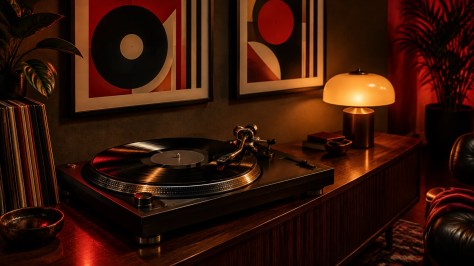
A dimly lit listening room with a black vinyl record on a turntable and abstract art in slim frames

Familiar records, another point of view

Faultline describes GROOVES as an invitation for artists to revisit iconic album covers in their own medium and voice. That makes the exhibition more than a wall of references. It’s a conversation between the records people carry with them and the artists looking at those images anew.

A painting can loosen a familiar image into color and gesture. A print can sharpen its graphic character. Mixed media can add depth, texture, and a sense of touch. Each approach gives visitors a new way to look, and perhaps to listen. What once seemed instantly recognizable might reveal an unexpected detail or bring back a memory you hadn’t thought of in years.

There’s something compelling about seeing a cover removed from its usual context. On a record sleeve, it’s part of an object you might pick up, turn over, and carry home. On a gallery wall, it has a different kind of presence. You can pause with it, notice its construction, and take in how an artist has transformed an image that already lives in the public imagination.

A wall of vinyl records and album sleeves hanging floor to ceiling in a record store

A wall of album art: the familiar landscape every collector knows. Photo via Pexels.

The music behind the image

At The Funk Jazz Lounge, we’re drawn to the places where music, art, poetry, and culture meet. Album art belongs naturally in that conversation. A cover doesn’t simply sit beside the sound; it can help shape the atmosphere in which the sound is received.

That feels especially true of records that become part of a listener’s personal landscape. The right sleeve can feel intimate and cinematic at once: a visual doorway into a song, a voice, an era. But the pleasure isn’t only nostalgia. Reimagined cover art can encourage us to listen more closely: to notice the choices behind an image, and the feeling that helped it endure.

Music and visual art also share a language of rhythm. A bold shape can hit like a drum accent; a repeated line can suggest a bass pattern; a wash of color might feel like a sustained note. Artists translate one kind of expression into another, and the audience brings its own memories to that exchange. You might recognize the inspiration immediately, or simply feel drawn to the artwork before knowing why.

Hands setting a blank, abstractly decorated record sleeve beside a turntable in warm gallery light

A reason to visit Faultline Gallery

GROOVES took place at Faultline Gallery, 3908 MacArthur Blvd, Oakland, from August 1 through August 29, 2026. The opening reception was scheduled for August 1, 6–9 p.m.; the gallery also welcomed visitors during the Laurel Street Fair on August 8, from 11 a.m. to 7 p.m. Regular gallery hours were Fridays and Saturdays, noon to 4 p.m.

For the exhibition details, visit Faultline Artspace’s GROOVES page. The show’s August run was a lovely reminder to keep an eye on local galleries: the next image that changes how you think about a familiar record may be closer than you expect.

Put on a soundtrack while you look

Whether you’re walking through an exhibition, revisiting a favorite sleeve at home, or letting your mind wander through music memories, a good soundtrack can make the moment richer. Tune into The Funk Jazz Lounge’s 24/7 stream while you view, browse, or make a little space for listening.

Explore The Funk Jazz Lounge for more music, poetry, art, and culture. Give the record, and the artwork that travels with it, your full attention. Sometimes the best way to see a groove is to let it play.